Shipping Container Foundation by Use: Storage, Office, or Home
The right shipping container foundation scales with the use. A storage box, a modified office, and a container home each need a different base.
 Editorial TeamEditorial Team9 min read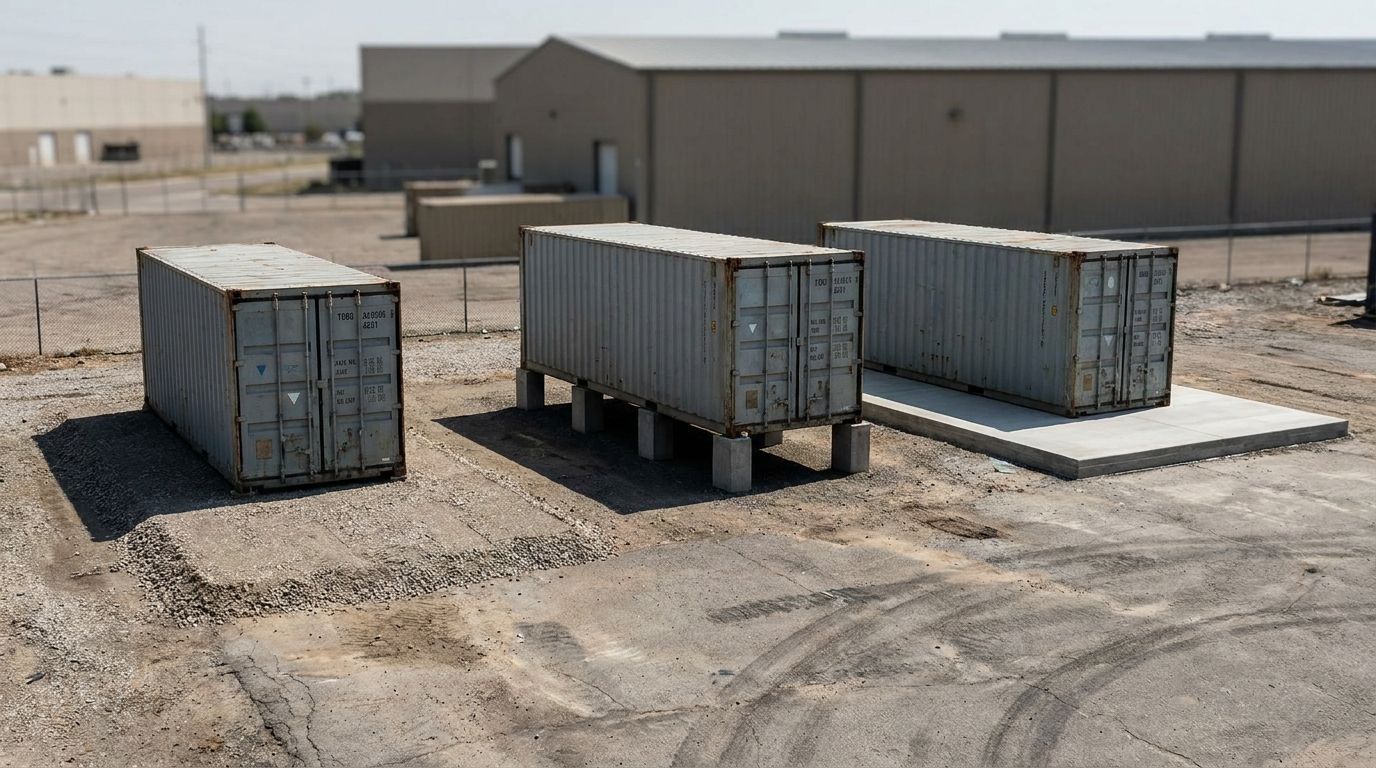
On this page
Quick answer: match the base to the use
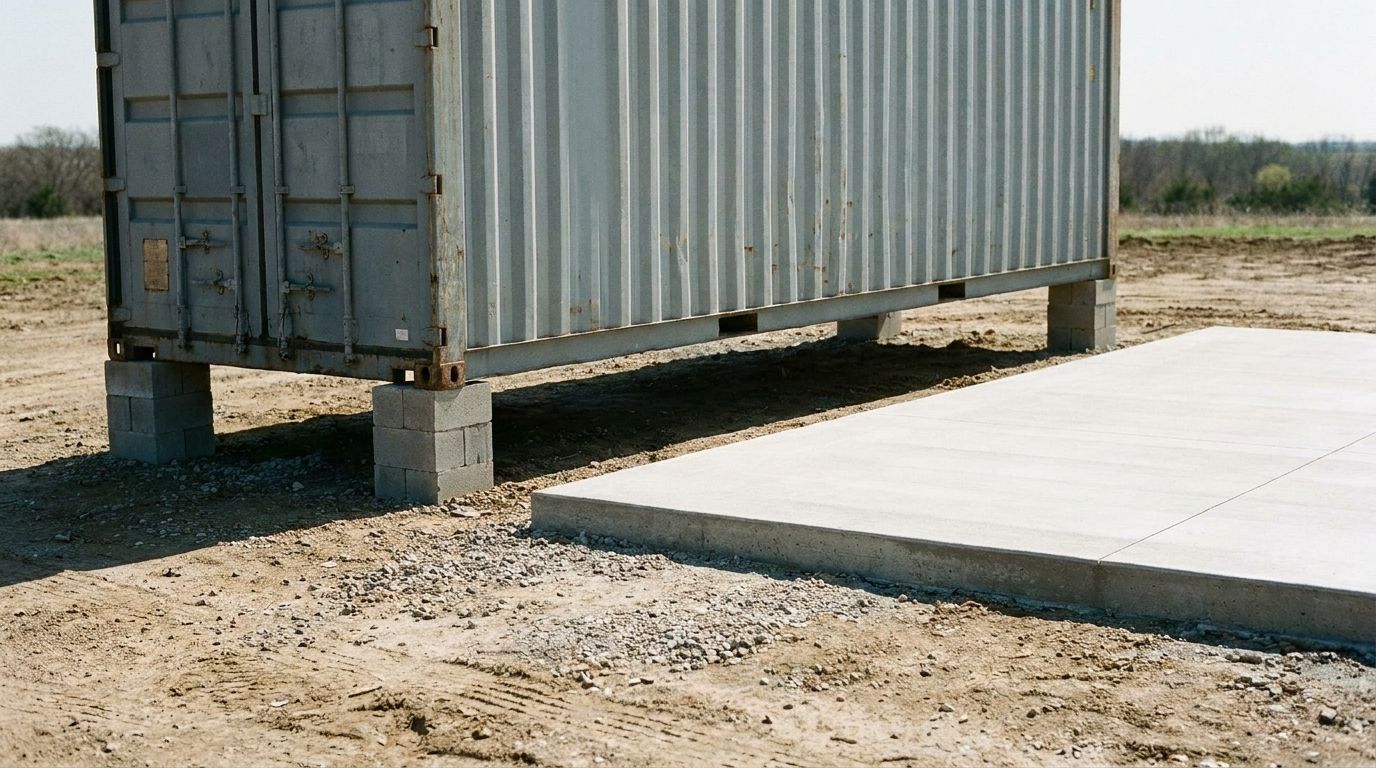
Match the base to what the container will do, not just to its size. For a sealed storage container, a compacted gravel pad is enough, or solid blocks under the 4 corner castings (the reinforced steel corner fittings the box rests and lifts on), because the box is rigid and you can re-level it. For a modified container office, step up to concrete piers or a slab with footings reaching below the frost line (the depth to which soil freezes locally), because cutting in doors and windows reduces the frame's rigidity and the unit is meant to stay put. For a container home, plan on an engineered slab or pier-and-footing foundation designed for your soil and climate, almost always with a permit and a code inspection. The rule of thumb: the more you cut the steel and the longer it stays, the stiffer, more level, and more permanent the base has to be.
Storage containers: the lightest base
A sealed storage container is the easy case, because the box does most of the work itself. A factory container is engineered as a self-supporting steel structure that transfers its load through the 4 corner castings and along the 2 bottom side rails (the long steel beams running the length of each side). It is rigid by design, it does not have to meet a building code as a habitable structure, and you can pick it up and re-level it if the ground shifts. That combination is why storage gets the lightest base.
For most storage units on reasonably firm ground, 2 options cover it:
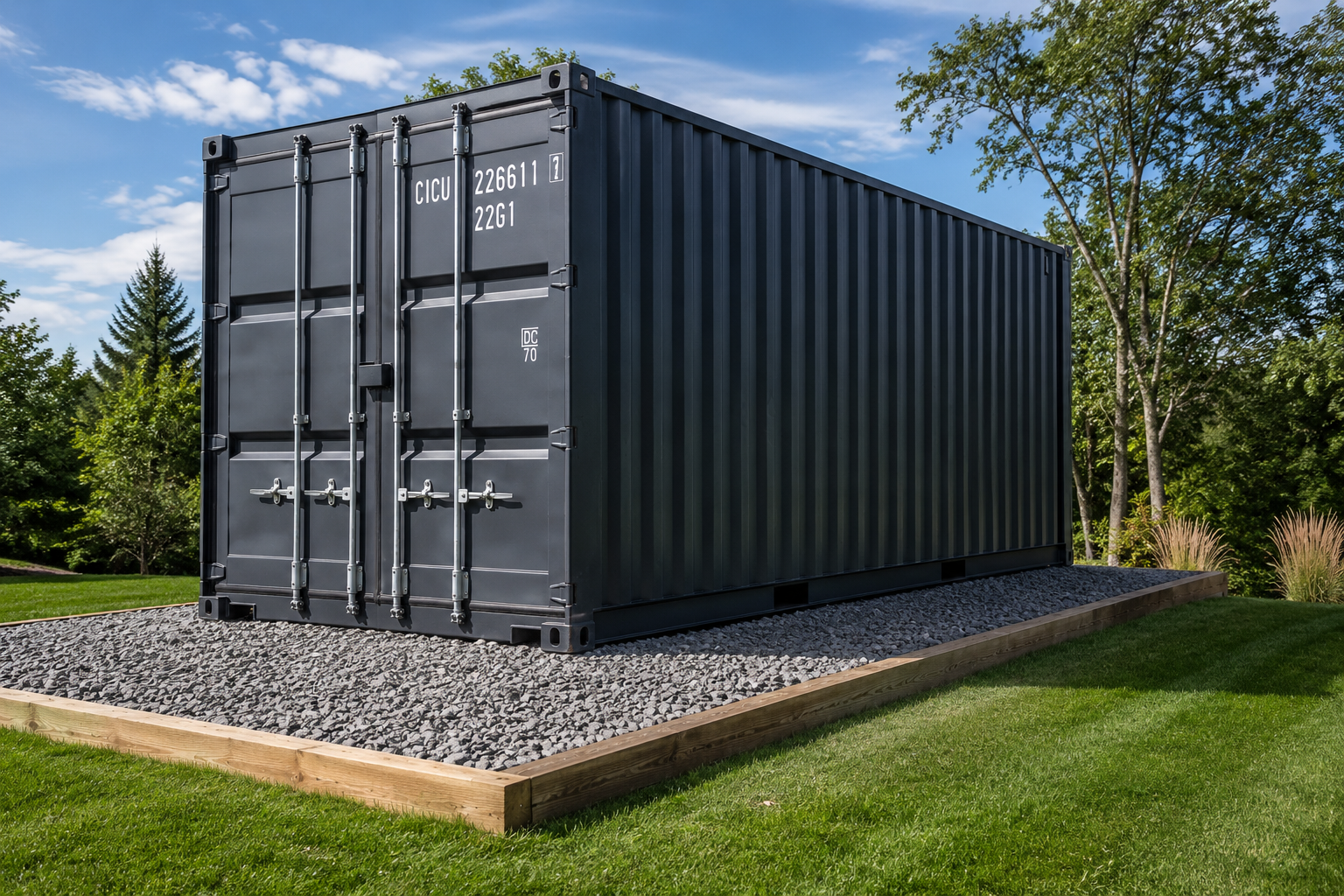
- A compacted gravel pad. Angular crushed stone, graded level and continuous under all 4 corners and both rails, drains water away from the steel and holds the unit firm. This is the most common storage base, and for good reason — it costs a fraction of concrete and performs just as well for a box. Our guide to building a shipping container gravel pad covers the footprint, depth, stone type, and drainage in full.
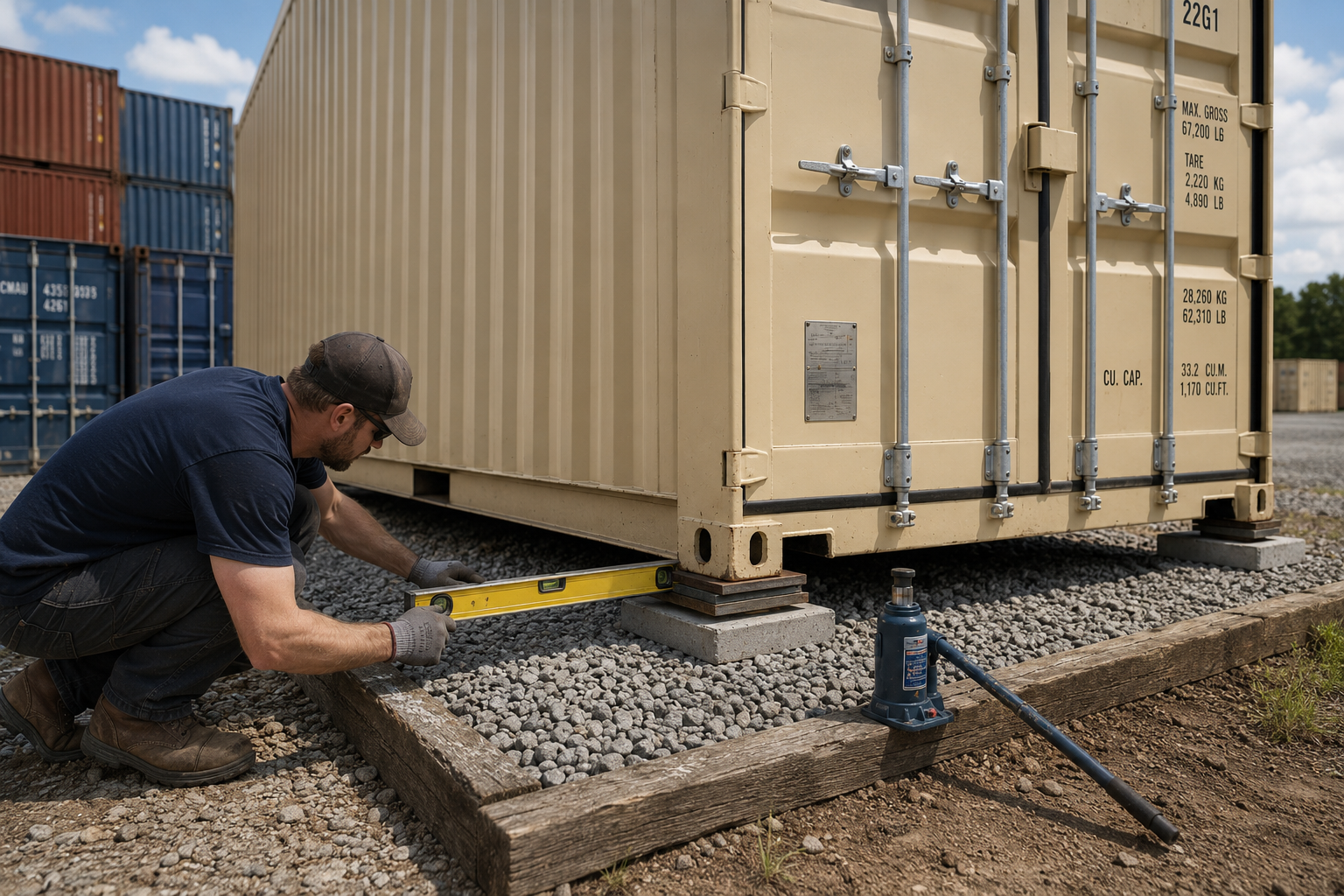
- Solid blocks or piers under the corners. On firm, well-draining ground, solid concrete blocks or short piers under the 4 corner castings (and the mid-points of a 40ft unit) give a clean, fast, low-cost base. The load goes where the container is built to carry it.
Either way, the goal is the same: keep the steel off wet soil and give it a firm, level plane to rest on. Set a box directly on dirt and it traps moisture under the floor and twists slightly on the uneven ground, which is when the doors stop closing square. Getting the unit truly level on the base matters as much as the base itself — our guide to leveling a shipping container walks the corner supports and the door-square test. The tradeoff with gravel and blocks is that they can move on very soft or sloped sites and do not anchor the unit against wind the way a slab can. For storage, though, you can re-level the box, so neither limit usually bites.
Modified container offices: more support
A container office changes the math, because you have started cutting the steel. A modified office typically gets a man-door, several windows, maybe a roll-up or a pair of side openings, plus interior framing, insulation, electrical, and HVAC. Every opening you cut removes a piece of the box's structural skin, and the finished unit is heavier, fitted out, and meant to stay in one place for years. So the base steps up in 3 ways.
It carries more, on a less rigid frame. A cut-open, fitted-out office concentrates more load on each corner than an empty box, and it does it through a frame that has lost some of its original stiffness. Concrete piers under the corner castings, or a slab, spread that load into the ground more reliably than gravel alone on a marginal site.
It has to stay level, because you cannot easily re-level it. A storage box on gravel can be jacked and re-shimmed. An office wired to the grid, plumbed, and finished inside is not something you want to lift twice a year. The base has to hold level on its own, which means footings that reach below the frost line so seasonal freeze and thaw (frost heave) do not lift a corner and rack (twist out of square) the frame, binding the doors and windows you paid to install.
It is usually a permitted structure. Once a container becomes an occupied workspace, many jurisdictions treat it as a building with a foundation requirement. That often means engineered piers or a slab rather than a pad you grade yourself.
For the full picture on specifying and siting a workspace unit, our container offices solution page covers the conversion and what the base has to support. A common, durable choice here is concrete piers with footings below the frost line, or a monolithic slab where you want a finished floor and an anchor point.
Container homes: an engineered foundation
A container home is a building, and it gets a building's foundation — designed by the numbers, not by rule of thumb. A home stacks the most demands on the base of any of these uses: it carries the most weight (often multiple containers, sometimes stacked), it removes the most steel (large openings for doors, windows, and joined units cut deeply into the structural skin), it must stay precisely level and stable for decades, and it has to satisfy a residential building code and a permit and inspection process.
That points to an engineered foundation: a poured slab, or a pier-and-footing system, designed for your specific soil bearing capacity, your local frost depth, and your seismic and wind loads. The defining word is engineered — the base is sized and detailed by a professional to documented loads, rather than picked from a general range. The reasons:
- Load and stacking. Joined or stacked containers concentrate large point loads at the corner castings where units meet. The foundation has to deliver those loads into competent soil without differential settlement that would crack finishes or rack a unit.
- Lost rigidity from large cuts. Home conversions cut the most material out of the steel — and as the next section explains, that is exactly what forces a stiffer base. The foundation, not the box, now provides much of the rigidity.
- Code, permits, and inspection. A dwelling has to meet residential code, which almost always specifies foundation type, footing depth, anchoring, and inspection sign-off. Treat this as general information, not legal advice, and confirm requirements with your local building department before you design anything.
This is the use where a gravel pad is clearly not enough and where the foundation belongs in the hands of a local engineer or builder who knows your jurisdiction.
Why cutting openings changes the base
The single idea that ties the 3 uses together is this: cutting openings into a container removes rigidity, so a modified unit needs a stiffer, more level base than a sealed one. This is why a home needs more base than an office, and an office more than a storage box, even at the same container size.
A factory container is strong as a whole. Its corrugated walls, roof, floor structure, and the welded frame act together as a rigid steel shell — close to a self-supporting bridge that spans between its corner supports. The corrugations in the side walls are a big part of that stiffness; they let the thin steel resist twisting. Cut a door or a window into a side wall and you interrupt those corrugations and remove a panel of working steel. The box does not collapse, but it loses some of its ability to hold itself square against twist. Cut several large openings, as a home does, and the unaltered shell can no longer carry the load on a few points the way it used to.
What gets lost has to be made up somewhere. Builders make it up 2 ways: by welding reinforcement (steel tube or angle framing) around the openings to restore some local stiffness, and by setting the unit on a stiffer, more continuous, more precisely level base so the now-less-rigid frame is fully and evenly supported and is never asked to bridge or twist. A sealed box tolerates a base that is firm at a few points. A heavily cut unit wants support that holds it flat and dead level everywhere, because it has less of its own structure left to absorb an imperfect base. That is the whole logic of scaling the foundation to the use.
Permits and code by use
How the base interacts with permitting also scales with the use, and this is general information, not legal advice — your local building department is the authority.
- Storage. A sealed container used purely for storage is often treated as a temporary or accessory structure, and many jurisdictions allow a gravel pad or blocks without a foundation permit. Some areas still regulate placement, setbacks, or duration, so it is worth a phone call before delivery.
- Office. Once people occupy the unit, the bar usually rises. Modified offices frequently trigger building-permit and foundation requirements, and sometimes electrical and accessibility review. The base you choose may need to satisfy an inspector, not just you.
- Home. A dwelling almost always requires a full permit, an engineered foundation, and code inspection covering footing depth, anchoring, and more. This is non-negotiable in most places.
The pattern matches the engineering: the more the use turns a box into a building, the more both the foundation and the paperwork ramp up. Check your local jurisdiction's requirements before you build, because they vary widely and they govern.
Frequently asked questions
Do I need a concrete foundation for a storage container?
Usually no. A sealed storage container is rigid and re-levelable, so a compacted gravel pad or solid blocks under the 4 corner castings is enough on reasonably firm ground. Concrete piers or a slab become worth it once the unit is heavy, permanent, or cut open for an office or home.
Why does a container office need a stronger base than a storage box?
Because cutting in doors and windows removes some of the box's structural rigidity, the office is heavier once it is fitted out, and a wired, finished unit cannot easily be re-leveled. So the base steps up to piers or a slab with footings below the frost line, which keeps the frame level and square without your intervention.
What foundation does a container home need?
An engineered one — a poured slab or a pier-and-footing system designed for your specific soil, frost depth, and wind or seismic loads, and sized by a professional rather than picked from a general range. A home carries the most weight, removes the most steel, and has to satisfy residential code, a permit, and inspection.
Does a shipping container foundation always need a permit?
It depends on the use and the jurisdiction, and this is general information, not legal advice. Pure storage is often allowed without a foundation permit; an occupied office frequently triggers building and foundation requirements; a home almost always requires a full permit and engineered foundation. Confirm with your local building department before you build.
For the complete framework on bases, footings, piers, and slabs across every use, see our shipping container foundations guide, the hub that ties these decisions together. And before the unit arrives, preparing your property for container delivery covers the access and clearance work that pairs with whatever base you build.
Not sure which base your project needs? Get a free quote and we will match the container and the base guidance to your use and your ground. A 20ft standard dry one-trip container is the general-purpose steel box for storage and many office conversions, and a 40ft high cube used container gives you more length and an extra foot of height (a high cube is 9ft 6in tall) for larger builds. Tell us the use, the soil, and the access when you reach out.