Concrete Piers vs Slab for a Shipping Container
Concrete piers vs a slab for a shipping container: where each carries the load, why the frost line decides, and how to match the base to your unit and use.
 Editorial TeamEditorial Team10 min read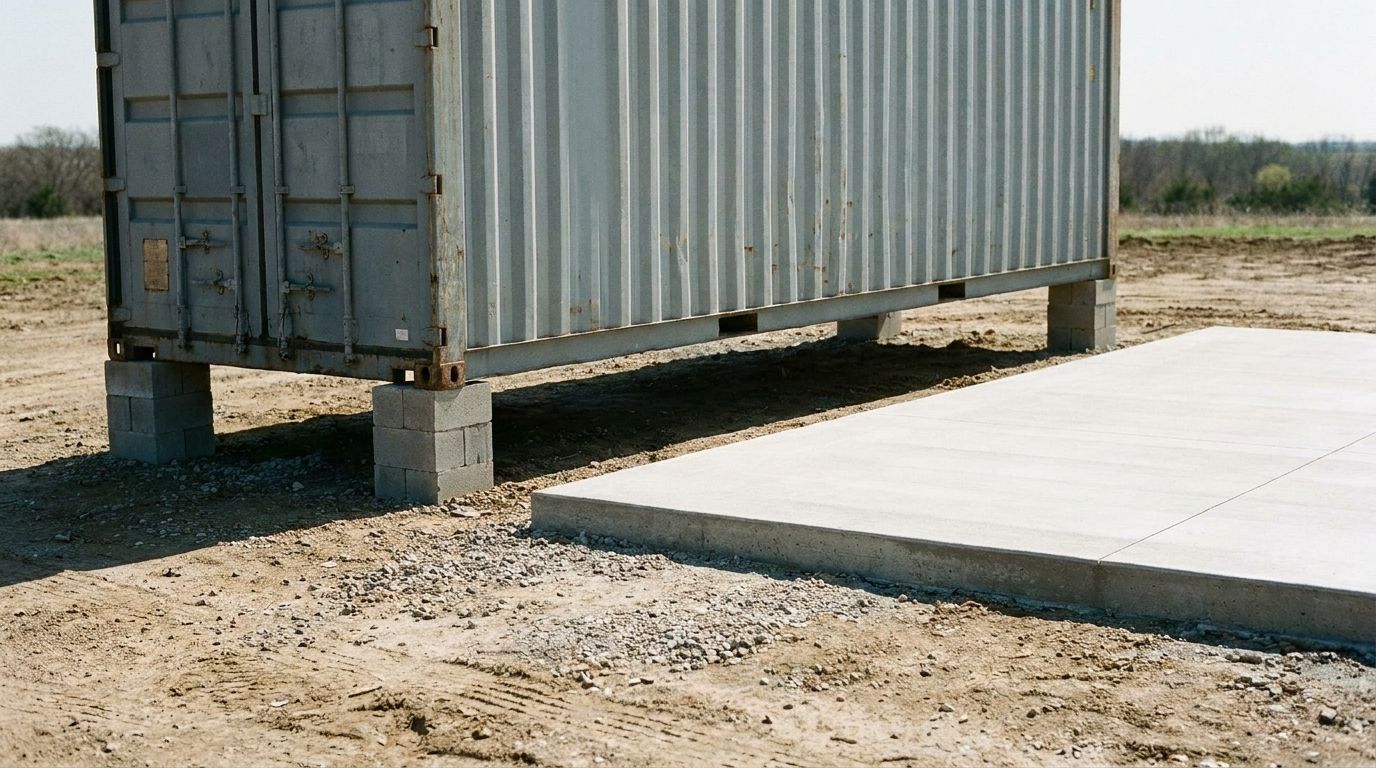
On this page
A shipping container does not carry its weight the way a house does. It is a steel box engineered to hang and stack from its 4 corner castings (the reinforced steel corner fittings used for lifting and stacking), with the load running down both bottom side rails (the long steel beams along each edge). That one fact decides the whole piers-versus-slab question. Concrete piers put support exactly where the container wants it — point loads under the corners. A slab puts a continuous concrete plane under the entire footprint. Both work. They solve different problems, and matching the base to the unit and the use is what keeps the box square, dry, and code-compliant for years.
This guide leads with the corner-load principle and the frost line (the depth to which soil freezes in your area), because those two ideas explain most of the decision before any cost or finish detail enters. Then it walks what piers and a slab each are, when each one wins, a head-to-head table, how to match the base to your container and use, and how soil and slope shift the answer. The engineering ranges here are general guidance; your soil, climate, and unit decide the specifics.
Quick answer: piers or slab?
For most siting decisions, concrete piers win when the container is a storage or work unit that stays movable, sits on a slope or soft ground, or needs footings to reach below the frost line, and you want to spend less than a full slab costs. A slab wins when the container is permanent, heavily modified, or finished into an office or home — anywhere you need to anchor against wind, want a clean dust-free floor, plan to run utilities through the base, or local building code calls for an engineered foundation. The deciding question is not "which is better" but "is this box staying movable, or becoming a building?" Piers support the corner castings as discrete footings; a slab supports the whole footprint and gives you a finished floor. Both must address the frost line wherever the ground freezes.
What concrete piers are (and when they win)
Concrete piers are individual footings (poured concrete pads, blocks, or sonotube columns) set under each of the 4 corner castings, with extra piers near the mid-span of the bottom rails on a longer unit. Each pier is a small, deep foundation carrying one bearing point. Because a container transfers its weight through the corners and rails rather than its floor, piers put concrete exactly under the load path and nowhere it isn't needed.
Piers win for several reasons.
They match the corner-load principle. A pier under each corner casting carries the box the way the steel is engineered to be carried. You support the 4 points that take the load, plus the rail mid-points on a 40ft unit, and skip paying to concrete the dead space under the floor.
They reach below the frost line. In cold-winter regions, water in the soil freezes and lifts the ground, then drops it on the thaw — frost heave. A pier dug and poured below the local frost line sits on ground that doesn't freeze, so it doesn't move with the seasons. This is the single biggest structural reason to choose poured piers over a surface base in a freezing climate.
They work on slopes and uneven ground. On a grade, you can pour each pier to a different height and bring all 4 corners into the same plane without excavating and forming a large flat slab. Piers let the container sit level on ground a slab would fight.
They cost less than a full slab. Piers use a fraction of the concrete, formwork, and cure area of a slab. For a storage or work unit that doesn't need a finished floor, that's capability you'd be paying for and not using. For how the base decision fits the overall budget, our guide to how much a shipping container costs breaks down the price drivers without guesswork.
The tradeoff: piers leave the ground under the container open, so you don't get a sealed, dust-free floor, and bare piers don't anchor the box against wind uplift as completely as a slab the unit is bolted to. For storage and most work uses, neither is a real limit. They are the reasons the permanent, finished cases move up to a slab.
What a slab is (and when it wins)
A concrete slab is a continuous poured pad, typically formed, reinforced, and finished, that covers the container's full footprint, often with a thickened, deepened edge (a footing) around the perimeter. Instead of 4 point supports, the box rests on one engineered plane. That plane does more than carry load.
A slab wins when the container stops being a movable box and becomes a building.
Permanent and modified units. A container office, a container home, or any unit cut open and finished out is a long-term structure. A slab gives it a stable, monolithic base that won't shift pier-to-pier, and its perimeter footing can be engineered below the frost line so the whole base moves as one — or not at all.
Anchoring against wind. A finished, occupied container catches wind like a building, and a slab gives you mass and embedded anchors to bolt the unit down against uplift and racking. This matters most for offices and homes in exposed or high-wind sites.
A clean, dust-free floor. A slab seals the ground under the unit. No dust pumping up, no pests or moisture migrating from open soil, and a hard surface right up to the door — worth it for a workshop, an office, or any space people occupy. Our container offices solution page covers the finish-out that pairs with a slab base.
A base for utilities. Plumbing, conduit, and drains can be cast into or routed through a slab before the pour, giving a finished unit a clean path for water, power, and waste. Piers leave that to run across open ground.
Code may require it. For a permanent or occupied structure, the local building authority may require an engineered foundation with footings below the frost line, and a slab is a common way to meet that. Treat permitting as general information, not legal advice — check what your jurisdiction requires before you build.
The tradeoff: a slab is the most material, labor, and cure time of any base, it's permanent (you're not relocating the container off it casually), and on a slope it needs far more excavation and forming than piers. For a storage box, that's money spent on capability the unit doesn't need.
Piers vs slab, head to head
Load path — piers give point support under the 4 corner castings, plus rail mid-points on a 40ft unit; a slab gives continuous support under the full footprint.
Best for — piers suit movable storage and work units, slopes, and soft or uneven ground; a slab suits permanent, modified, or occupied units such as offices and homes.
Frost line — each pier is poured below the local frost line; a slab uses a perimeter footing engineered below the frost line.
Slope — with piers you pour each to a different height to level the unit; a slab needs excavation and forming for a flat plane.
Wind anchoring — piers offer limited anchoring unless engineered and the unit is tied down; a slab is strong, with mass plus embedded anchors to bolt the unit.
Floor and dust — with piers the ground stays open under the box; a slab gives a sealed, clean, dust-free surface to the door.
Utilities — piers leave them routed across open ground; a slab lets you cast them in or route them through before the pour.
Material and effort — piers use less concrete and formwork and go faster; a slab is the most concrete, formwork, and cure time.
Relocatable — piers are easier to remove and re-site; a slab is a permanent base and the container stays.
Match it to your container and use
The unit and what you're doing with it point to the base more reliably than any single rule.
A 20ft storage or work unit on firm ground is the simplest case. Four piers under the corner castings carry it, or a well-built gravel pad does the job for a unit you might relocate. A 20ft standard dry one-trip container, the general-purpose steel box, rarely needs a slab unless you're finishing it into occupied space.
A 40ft unit is long enough that the bottom rails can sag between the ends, so piers need bearing points near the rail mid-span, not just the 4 corners — roughly 6 points. A 40ft high cube used container (a high cube is 9ft 6in tall, 1 foot taller than a standard container) carries the same corner-load rule; the extra height changes the volume, not where the weight goes.
A container office or home is where the slab earns its cost: anchoring, a sealed floor, cast-in utilities, and a base that satisfies code for an occupied structure. This is the clearest "becomes a building" case.
If you're weighing a gravel pad against concrete at all, our shipping container gravel pad guide covers the cheaper surface option and exactly where it stops being enough, and the shipping container foundations guide is the hub that ties pads, piers, and slabs together across the whole siting decision.
Frost line, soil, and slope
Three ground conditions move the answer regardless of the unit.
Frost line. Wherever the soil freezes, both piers and a slab footing have to reach below the local frost line, or seasonal frost heave will lift the base and rack the box. A surface base, gravel or a shallow slab, that doesn't reach below the frost line will move with the ground each winter. For a storage unit you can re-level, that may be acceptable; for a permanent or occupied unit, it isn't, which is why freezing climates push toward poured footings. Check your local frost depth before you choose.
Soil. Soft, wet, or expansive clay soil carries load poorly and shifts with moisture. Piers let you dig past the weak surface layer to firmer ground below; a slab on poor soil needs more reinforcement and a deeper, wider footing. Either way, the base has to be engineered for what the ground can actually carry, not assumed.
Slope. On a grade, piers are usually the lower-effort answer — pour each to its own height and bring the corners level. A slab on a slope means cut-and-fill excavation and tall forms, which is more work and cost. The steeper the site, the more piers pull ahead on effort.
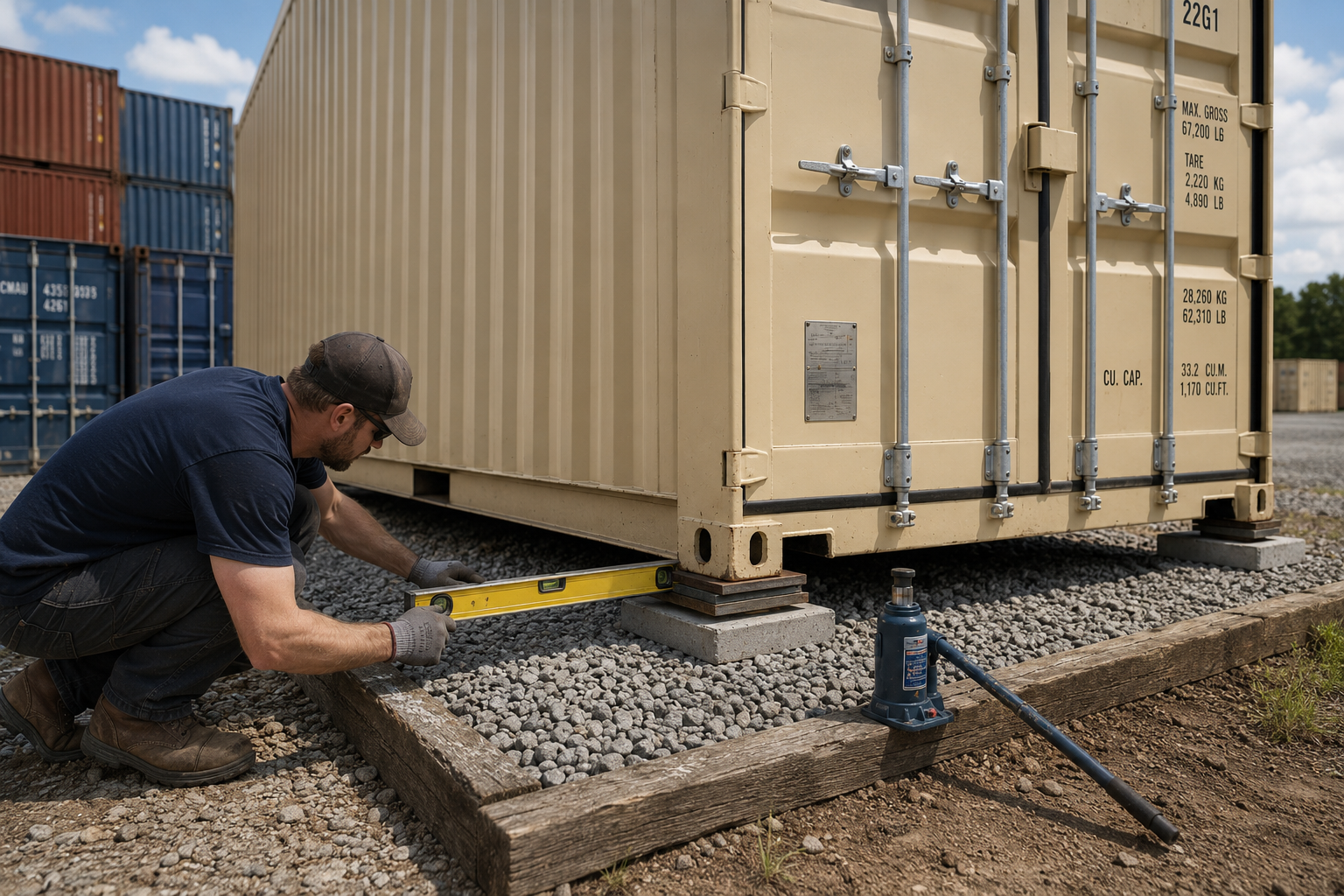
Whichever base you choose, the unit still has to land level on it. Once the piers or slab are set, our guide to how to level a shipping container covers supporting the corner castings, the door-square test, and the shims that take out the last fraction of an inch.
Cost and effort
Piers use less concrete, less formwork, and less cure time than a slab, so for a storage or work unit they're the lower-cost, lower-effort base that still does the structural job. A slab costs more in every dimension (material, labor, and cure) but buys anchoring, a sealed floor, utilities, and code compliance that a finished or occupied unit needs. We don't quote base figures here, because they swing with your soil, frost depth, slope, unit size, and local concrete and labor rates. For how the base decision fits the total, see how much a shipping container costs, and bring your site details when you reach out so the estimate reflects your ground rather than an average. The access and drop-zone work that comes before any pour is covered in preparing your property for container delivery.
Frequently asked questions
Are concrete piers strong enough for a shipping container?
Yes. A container transfers its load through the 4 corner castings and bottom side rails, not its floor, so piers placed under those points carry the box the way it's engineered to be carried. On a 40ft unit, add bearing points near the rail mid-span so the rails don't sag between the ends.
When do I need a slab instead of piers?
Choose a slab when the container becomes a permanent or occupied structure — a container office or home, or any unit cut open and finished out. A slab anchors the box against wind, seals the floor against dust and moisture, lets you cast in utilities, and is a common way to meet a building code requirement for an engineered foundation.
Do piers or a slab have to go below the frost line?
In any climate where the soil freezes, yes. Frost heave lifts the ground each winter and drops it on the thaw, so a base that doesn't reach below the local frost line will move and rack the container. Piers are dug and poured below that depth; a slab uses a perimeter footing engineered below it.
Can I use concrete piers on a slope?
Piers are often the better choice on a slope. You pour each pier to a different height and bring all 4 corners into the same plane, leveling the unit without the cut-and-fill excavation and tall forming a slab would need on the same grade.